
Blue Spring (Te Waihou Walkway)
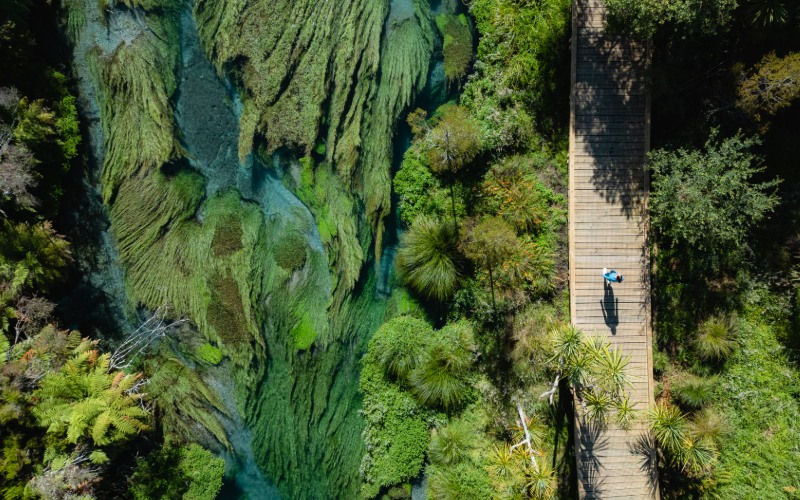
Blue Spring, on the Te Waihou Walkway near Putaruru in the Waikato, is about as clear as fresh water gets — a spring-fed stretch of the Waihou River with visibility reported at 60 metres or more, and the source behind a large share of New Zealand's bottled water.
History and Significance
The water reaching Blue Spring fell as rain on the Mamaku Plateau decades ago, and spends an estimated 50 to 100 years filtering slowly through volcanic rock before emerging here at a near-constant 11°C year-round — a filtration process long enough that the water arriving today fell as rain around the time your grandparents were young. That extended natural filtration is what gives the spring its exceptional clarity and vivid blue-green colour.
The spring discharges roughly 42 cubic metres of water every minute — enough to fill a six-lane, 25-metre swimming pool in a little over 12 minutes. Locally, the South Waikato District Council draws water from the spring under a resource consent and supplies it onward to bottlers under a legal agreement — worth knowing, since it's the council's supply arrangement rather than bottlers drawing directly from the spring themselves. Around half of Putaruru township, along with a small number of bottling properties, relies on this source.
The wider Waihou River also carries genuine historical significance for local Māori — it was a key travel route for Kīngi Tāwhiao, the second Māori King, providing both food and flax along its length, and remains connected to Raukawa iwi in the region today.
What to See
The spring itself — an alcove in the riverbed roughly 800 metres along the walkway from the Leslie Road entrance, with a viewing platform directly across from it
Trout and native aquatic plant life — clearly visible given the water's exceptional clarity, even from the bank
Small waterfalls and wetlands along the longer Whites Road route
Native bush and rolling farmland framing much of the walkway
Practical Visiting Tips
There are two access points, and they offer quite different experiences. The Leslie Road entrance gets you to the main spring viewing point in around 15–20 minutes each way — the practical choice for families or a quick visit. The Whites Road entrance is the fuller experience, a roughly 4.7km (about 45 minutes to 2.5 hours, depending on pace and how far you go) one-way walk through farmland, wetlands, and native bush.
Swimming rules are more specific than they're often described online. Swimming and wading directly at the Blue Spring itself, and immediately upstream, damages the fragile riverbank habitat and is strongly discouraged (some sources describe it as prohibited) — but swimming remains permitted further along the walkway at the Whites Road end. If a swim is part of your plan, do it there, not at the spring itself.
Check current track status before you go. The walkway has had periods of temporary closure, so don't assume access without checking current South Waikato District Council information first.
The track surface varies — farm track, boardwalk, and some stairs, with muddy patches common after rain. Wear appropriate footwear.
There are no rubbish bins along the track — pack out everything you bring in.
It's free to visit, with no entry fee at either access point.
No public transport serves the walkway directly — you'll need your own transport or an organised tour to get there.
Fishing is allowed with a valid licence, available from council offices in Tīrau or Tokoroa, or the Putāruru Information Centre.
Frequently Asked Questions
Can I swim at Blue Spring? Not at the spring itself or immediately upstream — this is discouraged to protect the riverbank habitat. Swimming is permitted further along the walkway at the Whites Road end.
How far is Blue Spring from Auckland? Roughly two hours' drive, and just over an hour from Rotorua, making it a workable stop between the two or a standalone day trip from either.
Which entrance should I use — Leslie Road or Whites Road? Leslie Road for a quick visit focused on the spring itself (15–20 minutes each way); Whites Road for the fuller walkway experience through farmland and wetlands, at considerably more time and distance.
Is it true this water supplies New Zealand's bottled water? Yes, in large part — though the water is drawn by the local council under a resource consent and supplied onward to bottlers under agreement, rather than bottlers taking water directly from the spring themselves.
Getting Here from Auckland or Rotorua
Blue Spring sits conveniently between Auckland and Rotorua, making it a natural stop on a wider Waikato or Central Plateau itinerary. A private day trip with Hopon can include Blue Spring alongside other Waikato stops like Waitomo or Hobbiton, without needing to self-drive to a spot with no public transport access.
Blue Spring rewards a slower look rather than a quick photo — the water's clarity is genuinely striking in person, and it's one of the few places in New Zealand where you can watch trout swim past as if there were no water there at all.

